

New to no-tie laces? See every type of no-tie shoelace explained in our full guide →
The best elastic no-tie shoelaces for running and sports flex with your feet, never need retying mid-run, and turn race-day transitions into a slip-on. You set the tension once and the elastic does the rest. Here is where each style fits.
Long-distance running
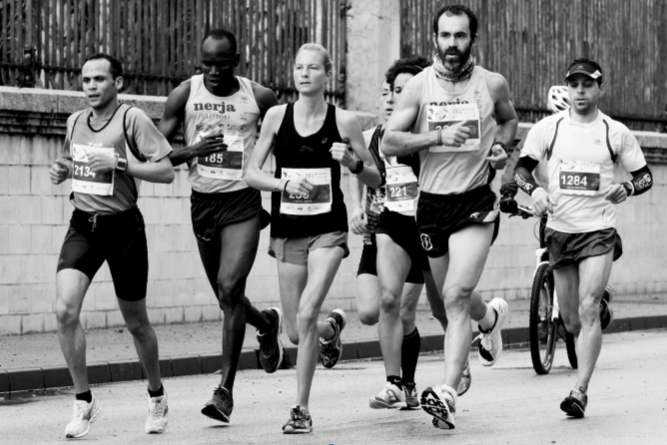
Feet swell during runs, especially past mile 18, and regular laces start to cut in right when you have the least patience for it. Elastic laces flex with the swell and return to baseline tension as your feet recover, so the pressure stays even instead of spiking. No retying mid-run, no hot spots from a lace that was perfect at the start line and a tourniquet by the finish.
Triathlon transitions
Transitions are time, and laces are where transitions go wrong. Tying both shoes in T1 and T2 costs you 15 to 30 seconds you never get back, plus the risk of fumbling a knot with adrenaline-numb fingers. Elastic laces on your run shoes turn that into a slip-on: foot in, go.
High-impact and field sports
Cleats and court shoes need locked-in tension that does not drift mid-game. Our Quick Lock style is built for this, an elastic core with a toggle that lets you set tension precisely and change it per event. Run prep, soccer practice, and a basketball game can all run on the same shoes at different tension levels, set in seconds.
When traditional laces still win
If your sport means relacing mid-event with big tension changes, like gymnastics or lifting where you move between events, traditional laces still have the edge. For everything else in running and casual sport, elastic is the upgrade.
How to install them (one time)
- Pull your existing laces out.
- Thread the elastic laces through the same eyelets, in the same pattern.
- With the shoe on the foot, snug them to the tension you would normally tie at, not tighter. The elastic gives where it needs to.
- Tie them off once and trim any extra tail. That is the only time you tie them.
It takes a few minutes per shoe, and you only do it once. On race day there is nothing to tie, so the shoe is a slip-on from the moment you step in.
What length to order
Most adult running shoes take the 45-inch lace. Lower-cut racing flats with fewer eyelets take 35 or 40 inches; high-top court shoes take 63 inches. Quick Lock comes ready to fit standard athletic shoes. Sizing goes by eyelet count and lacing height, not foot size; the length guide has the full chart.
Which style to choose
- Flat or Round elastic for daily training and racing where you set tension once and forget it.
- Quick Lock for field and court sports where you want a toggle to fine-tune tension per event.
What customers say
"I am a long distance runner (full and half marathons) and I run over 1600 miles a year. One of the most frustrating things is stopping to tie or loosen your laces as your feet swell. Not with these. Tie them once and forget about them, they expand with your feet."
R. Lierman
Stretchlace has been seen on Shark Tank, stocked in REI nationwide, and earned 4.5 stars across 7,000+ verified reviews.
Common questions
Do they come undone during a run?
No. You tie them once at install and the elastic holds that tension. There is no bow to shake loose and no mid-run retie.
Are they allowed in races?
For road running and triathlon they are standard and widely used. Check the rules of any specific governing body for your event.
Standard elastic or Quick Lock?
Standard elastic for running and casual sport where you set tension once. Quick Lock for field and court sports where you fine-tune tension per event.